
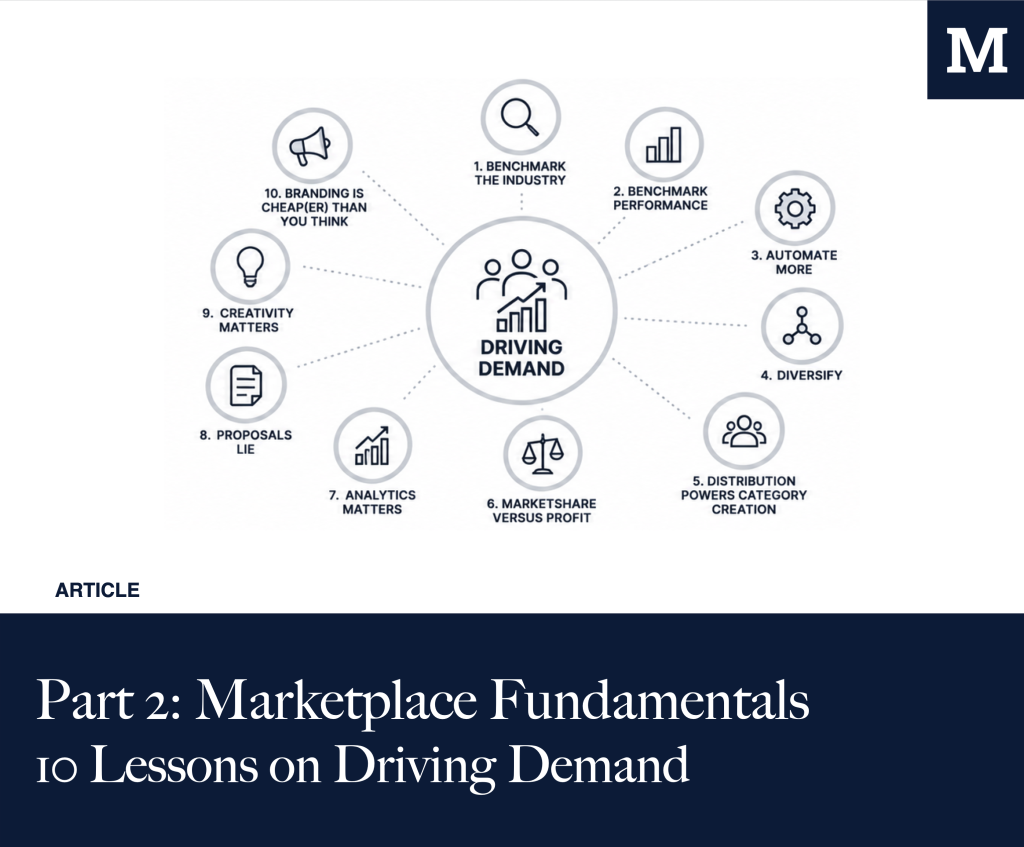
Back in February, I promised to write down more lessons learned from building Marketplaces after my journey at RVshare ended. It took a while to pick up my writing again, but here we are for part two, and my specific lessons around demand are in random order:
Driving Demand for Marketplaces
1. Benchmark the Industry: Understand how demand is distributed across your category before deciding where to invest.
Different industries develop very different channel mixes, and those differences can expose major opportunities. Look at how established players divide demand across organic search, paid marketing, affiliates, partnerships, direct traffic, lifecycle, and other channels. You do not need to copy the mix, but you should understand why it exists.
Example: In the early days at RVshare, U found that travel companies could generate roughly 10% of their demand through affiliates and partnerships, while our contribution from the channel was effectively zero at that point. That gap made the opportunity obvious and became one reason we invested heavily in building partnerships and affiliate distribution.
2. Benchmark Performance: Build your own benchmarks for what good performance looks like. The more campaigns, partnerships, media deals, and distribution agreements you run, the better you should become at predicting whether the next one can work.
Track proposals and actual results, including CPMs, CPCs, conversion rates, CAC, and ultimately the economics that matter to your marketplace. Over time, you develop clear ranges for what you can afford to pay and what performance a partner needs to deliver. That makes evaluating new opportunities much faster and gives you significantly more leverage when negotiating.
Example: After doing enough partnership and media deals at RVshare, we could often look at a pricing proposal and quickly determine whether the economics were even remotely likely to work. Every deal you run should make you better at evaluating the next one.
3. Automate More: The more your growth team can automate, the more time it can spend on execution, experimentation, and creativity.
Product feeds, click data, campaign reporting, partner performance, and other recurring inputs should flow into dashboards and reporting pipelines wherever possible. We invested heavily in this because we did not want the team spending hours every week pulling the same reports, cleaning the same files, or rebuilding the same analyses. This is even easier today. AI and modern data tooling make it much faster to build pipelines, automate reporting, flag anomalies, and surface the information teams actually need. A surprising amount of underperformance still comes from teams doing too much manually. Good automation does not replace the team. It gives the team more time to do the work that actually requires judgment.
4. Diversify: Do not let one acquisition channel become your entire growth strategy.
Marketplaces often lean heavily on organic search because the economics can be incredibly attractive, especially once supply creates thousands or millions of pages that capture long tail demand. But that strength can also create dependency. Algorithms change, competition increases, and channels eventually mature. The strongest marketplaces build demand across multiple sources: SEO, paid acquisition, affiliates, partnerships, lifecycle, creators, brand, and other forms of distribution. That also means building a team with enough range to operate across those channels instead of becoming exceptionally good at only one.
Diversification is not about spending equally everywhere. It is about making sure the marketplace can continue growing when one channel stops performing the way it used to.
5. Distribution Powers Category Creation: One of the most powerful growth opportunities for a marketplace is often distributing its inventory through platforms that already have large, relevant audiences.
Many of these partners have no interest in building a marketplace themselves. Building supply, payments, trust, customer support, availability, and all the other infrastructure required is expensive. Instead, they would rather distribute inventory that already exists, provide value to their audience, and take a share of the economics. That can create an attractive deal for both sides. The marketplace gains access to a massive pool of customers that could be expensive to acquire directly, while the partner adds a useful product without having to build the underlying marketplace.
The more places your supply can intelligently be distributed, the larger the category can become.
6. Marketshare versus Profit: There is a time to optimize for market share and a time to optimize for profitability. In competitive marketplaces, trying to maximize both at the same time is usually unrealistic.
A market share strategy may mean accepting higher acquisition costs, investing aggressively in channels, expanding distribution, or spending ahead of the economics you ultimately want. A profitability strategy requires a different mindset, with tighter efficiency thresholds and more discipline around where growth comes from. The important part is being explicit about which one you are pursuing. That decision needs alignment across leadership, finance, investors, and anyone else evaluating performance. Otherwise one part of the company may be optimizing for growth while another is questioning why margins are declining.
Pick the strategy, understand the tradeoffs, and make sure everyone is measuring success against the same goal.
7. Analytics Matters: You should be able to understand performance as deeply as the channel allows. We wanted visibility into every channel and, where possible, every campaign and individual ad. Over time, that data became valuable for much more than deciding where to spend the next dollar. It helped us understand which messages resonated, which product features mattered most to customers, and which campaigns were simply benefiting from existing category demand.
Getting there requires robust analytics infrastructure. Internal product and transaction data needs to connect with advertising platforms, attribution systems, partner reporting, and any external data sources that can add context. The quality of your decisions is often limited by the quality of the data flowing into them. Invest in measurement early enough that you are not trying to reconstruct the answers months later.
8. Proposals Lie: Treat every partner proposal as marketing material, not as a source of truth.
Proposals are usually filled with audience demographics, traffic numbers, case studies, and historical performance. The problem is that much of this information may be months or even years old. Websites change, audiences shift, traffic sources evolve, and few partnership teams are rebuilding their sales deck every six months. The data can still be useful, particularly for understanding what portion of an audience is actually relevant to you. At RVshare, for example, we generally were not focused on customers under 25. If a potential partner told us that 20% of their audience fell into that group, we would effectively discount that portion of their reach before calculating what the partnership was worth.
Do not price a partnership based on the audience they claim to have. Price it based on the audience that is actually valuable to you.
9. Creativity Matters: Some of the best demand generation ideas are surprisingly cheap to execute.
Later at RVshare, the team became incredibly good at finding interesting concepts, data points, stories, and cultural moments that could generate PR coverage or social attention without requiring large media budgets. A creative idea with the right angle could travel much further than another campaign backed by paid distribution. Your content, social, and PR teams are often especially good sources for these ideas because they spend every day watching what people are talking about, sharing, and reacting to. Give them room to turn those observations into campaigns.
Not every growth idea needs a large budget. Sometimes the idea itself is the distribution.
10. Branding is Cheap(er) than you think: Brand investments can look expensive when you evaluate them only on the day you make them.
A few years into RVshare, we invested substantially in brand assets. There were understandable questions about the upfront cost, but the useful life of those assets changed the economics considerably. Depending on the type of expense and its accounting treatment, working closely with finance can also help you understand when costs are expensed and when they can be spread over a longer period.
More importantly, strong creative can last much longer than expected. Photography, video, campaign concepts, and other brand assets can sometimes remain useful for three, four, or even five years. Viewed across their entire useful life, the cost can look very different from the initial production budget. Creators make this even more attractive today. People are already traveling, taking photos, shooting videos, and telling stories about the categories marketplaces operate in. With the right permissions and agreements, that content can become advertising creative, organic social content, destination imagery, and other reusable brand assets.
The upfront cost of ‘brand’ can be high. The cost per use often is not.
In the last post in this series, I’ll try to answer more insight around driving Supply and the layers of sophistication.