
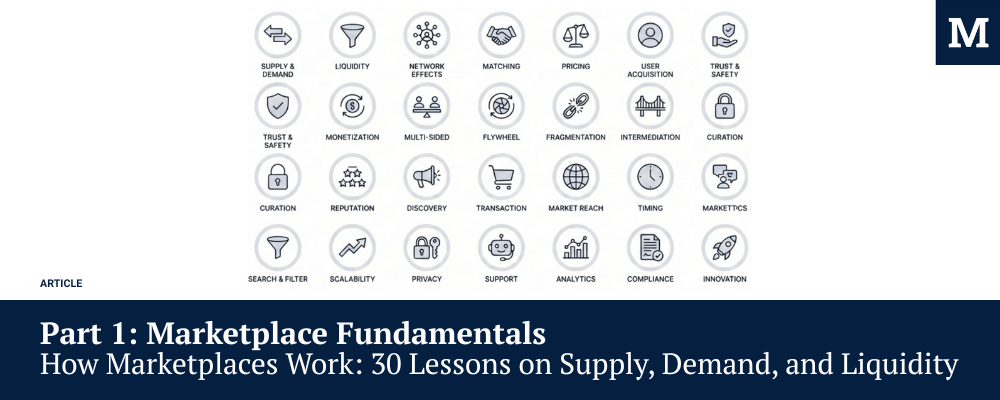
Building marketplaces is what drives me. Over the years, I picked up a lot of knowledge about what makes them work and the mistakes I’ve seen (mainly my own). In my previous blog post, I shared my personal insights from my time at RVshare and promised to share more about building marketplaces.
There are lessons I keep seeing repeated across marketplaces, in the first of three we’ll discuss the fundamentals:
Marketplace Fundamentals
1. Leverage Distribution: Distribution powers the product’s market fit. Distribution isn’t created by itself; early on, there is no network effect for a product (the classic chicken-and-egg problem). The old adage of: a good product will market itself, I’ve rarely ever seen come to life, and it is only often true when there is a viral product loop involved (a rarity for marketplaces). As you’re likely onboarding Supply first, it’s important to quickly drive distribution for supply partners. One way to do that early on is by building out your organic (search & social) channels, as they can likely scale with you over time and help distribute demand & inventory when you start growing.
2. Avoid Stale Supply Availability: The biggest marketplace risk is the silent one: stale supply availability. Nothing destroys trust faster than “bookable” inventory that isn’t. This is where Product Marketing really comes in to keep supply active. Stale supply increases the need to acquire additional supply and deteriorates liquidity.
Example: At Postmates, a new driver had to complete X deliveries within a certain timeframe; otherwise, they were likely to churn early. Taking this into account when distributing orders to your Supply is important when you don’t have scale yet.
3. Ecosystems Matter; Leverage the Ecosystem (Partners) to build a category. Invest early in building relationships, as it takes a long time.
Example: RVshare was a newer category within Travel, while we relied on an extensive network of partners, I should have accelerated this even faster in years 1-2 (we likely only did in years 3-4) to help build the category and support the ecosystem.
4. Optimize Take Rate: In newer categories, you can optimize take rate upward; in more competitive ones, you can gain an advantage in supply acquisition by maintaining a low take rate and offering a higher margin to supply partners. But be aware that you can experiment with this. While you can only optimize take rate so many times, it’s a useful lever that many growth leaders forget when scaling marketplaces.
5. Marketshare Player versus Category Creation; Many marketplaces are market share players not category creators, but founders often forget this. Only true unicorns like Uber expanded existing categories (taxis) and inspired new category creation (of which they have a dominant (local) market share).
6. Be(come) the system-of-record; If your marketplace doesn’t become the system of record for trust, you’ll compete on price forever. This is why there is a strong notion for marketplaces to provide more than demand (the Marketplace+ model applies this). This works extremely well when demand & supply are consumers (UberX, Airbnb).
7. Missing Integrations are a growth constraint; If onboarding supply isn’t repeatable, nothing compounds. In Travel this often includes aggregating inventory from different places/systems. Or even being OK with a 0% take rate to maintain full inventory (see the case of Ryanair integrating with OTAs).
8. Create Trust; Marketplaces win by reducing uncertainty: policies, reviews, verification, response times, protections. Every trust improvement shows up in visits, conversions, AOV, and repeat purchases.
Example: Google reviews, TrustPilot, signaling payment options, supply reviews.
9. Do Things that Don’t Scale; Classic. We worked on optimizing photos for supply details, going one by one and organizing photo shoots. We ran event marketing/activations at 15+ large festivals in 2022, none of which scaled easily. You’ll learn over time what works and scale processes from there. Certain things do require scale from day one, like SEO. You can’t scale SEO, in my opinion, by publishing just another blog post each week.
10. Be (more) Efficient; Every dollar you can save is an incentive going forward. Apply it to a commitment to use brand assets longer, so you can pre-buy more inventory at cheaper unit cost. But also, we hosted photo shoots in the teams front-yard. New AI-solutions will make this easier and easier and looking back would have saved headcount and reduced marketing spending by millions.
In the next post, which I hope to publish next week, we’ll talk more about the Supply side of marketplaces.